The AI ROI Problem: Why 56% of CEOs See No Financial Impact — and How to Fix It
You have the strategy. You have the playbook. Your board wants one thing: proof. Here is the ROI math that separates AI investments that compound from AI experiments that get canceled.
One runtime for memory, orchestration, governance, and action across your business.
Voice, chat, email, SMS, video, and documents working as one continuous operating surface.
Not more answers. Not more copilots. Work that actually gets completed and moved forward.
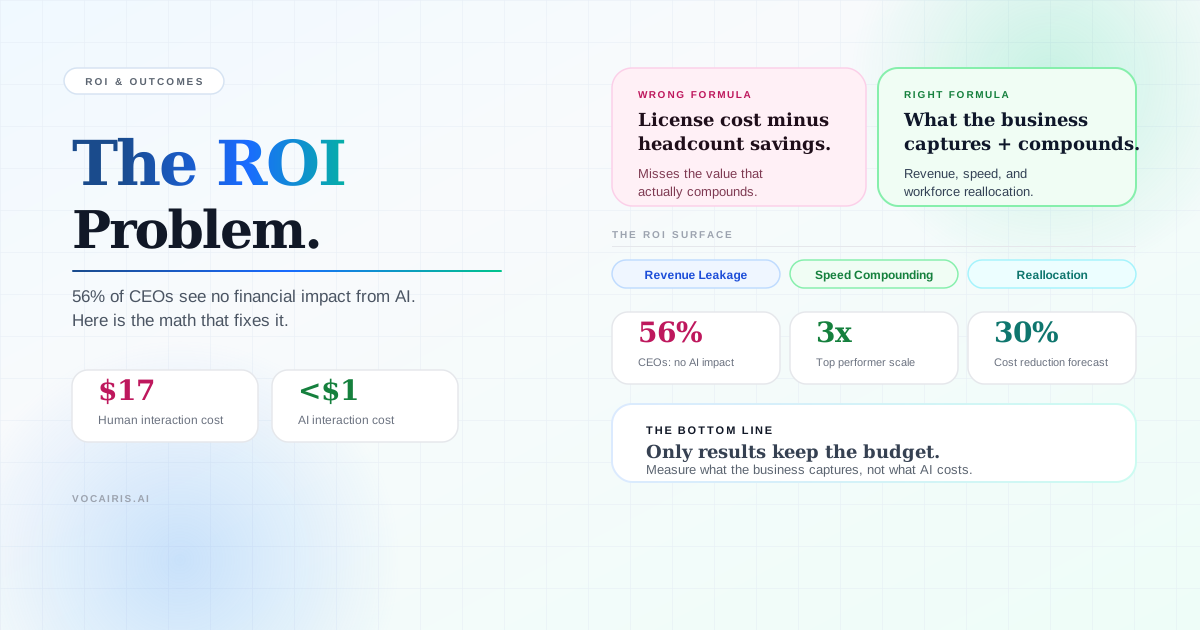
Strategy gets funded. Execution gets approved. Only results keep the budget.
We laid out the new AI operating model — why scattered tools and vendor-locked agents fail. Then we published the implementation playbook — six steps from pilot purgatory to production.
Both posts surfaced the same question from every CFO in the room:
Show me the numbers.
This is the ROI math.
The Measurement Crisis
PwC's 2026 Global CEO Survey: 56% of CEOs report no financial impact from AI despite broad adoption. The Conference Board: 41% of executives say measuring AI ROI is their single biggest AI priority — outranking model selection, talent, and security.
Deloitte's State of AI in the Enterprise: only 20% of organizations are generating revenue growth from AI, even though 74% expect it. Two-thirds report efficiency gains they cannot connect to a dollar figure the board cares about.
The pattern: companies are measuring AI activity, not AI outcomes. That is not a semantic distinction. It is the difference between keeping your AI budget and losing it.
Why Most AI ROI Calculations Are Wrong
Enterprise AI business cases typically model license cost minus headcount savings. This framework misses three categories of value that dwarf direct cost savings.
Revenue leakage you stopped. Every dropped interaction — unanswered call, abandoned chat, 48-hour email response — is lost revenue. For enterprises handling thousands of inbound interactions monthly, even modest capture-rate improvements translate to seven-figure annual revenue recovery. The math scales with volume, and at $100M+ companies, the volume is substantial.
Speed-to-resolution compounding. Industry benchmarks show AI cutting first-response times from six hours to under four minutes and resolution times by up to 87%. At enterprise scale, that speed reduces escalations, repeat contacts, and churn — each compounding over time.
Workforce reallocation, not reduction. The ROI mistake: modeling headcount elimination. The organizations seeing real returns redeploy people to high-value work — closing deals, retaining accounts, solving novel problems. That reallocation generates revenue that never appears in a cost-reduction spreadsheet.
The real formula: not what AI costs versus saves, but what the business captures and compounds when AI handles volume work and humans handle judgment work.
The Unit Economics of Unified AI
A human agent interaction costs $17+. An AI-handled interaction costs less than a dollar. That is structural, not marginal.
But the real enterprise savings come from unification.
When a customer chats Monday, calls Tuesday, and emails Wednesday, siloed systems treat those as three interactions — three costs, three context-rebuilds, three failure points. A unified AI layer treats them as one continuous conversation. One context. One resolution. One cost.
At enterprise volume, that architectural difference is worth millions annually. Gartner projects conversational AI will cut contact center labor costs by $80 billion, and predicts agentic AI will drive a 30% reduction in operational costs for customer service by 2029. The organizations capturing the top end of those savings are the ones with unified orchestration — not just point automation.
The Compounding Effect
AI ROI is not linear. It compounds — and this is what most business cases miss.
First wave (6–18 months): efficiency gains. Fewer manual touches, faster processing, lower error rates. Table stakes.
Second wave (12–36 months): process redesign. New capabilities that were impossible before. Revenue patterns AI surfaces that humans never could.
By year three, the gap is structural. McKinsey's 2025 State of AI found that AI high performers — roughly 6% of organizations — are more than three times as likely to pursue transformative change and report meaningful EBIT impact. BCG's 2026 AI Radar found top performers expect twice the revenue growth and 40% greater cost reductions — not from better models, but from compounding earlier.
This is the timing argument. The competitive advantage from unified AI is not about doing things better. It is about compounding faster than competitors who started later.
Building the Board-Ready Business Case
Business cases that die in the boardroom lead with technology. The ones that survive lead with three numbers.
Cost of inaction. Quantify what unanswered interactions, manual reconciliation, and siloed handoffs cost today. Include revenue leakage. This number is almost always larger than the proposed investment.
Time to measurable impact. Boards do not fund three-year promises. Show a 60-to-90-day path to first returns. One workflow, one channel, real data — results within one quarter.
Outcome metrics. Tickets deflected is activity. Cost per resolution is outcome. Calls answered is activity. Revenue captured per interaction is outcome. The shift is subtle but it separates a purchase justification from an expansion justification.
What VocAIris Delivers
Siloed tools produce siloed metrics. VocAIris solves this structurally:
- Unified cost tracking — one cost-per-resolution metric across voice, chat, email, text, video, and documents
- Revenue attribution — every AI interaction tied to a business outcome, not a ticket status
- Compounding baselines — performance improves over time and the dashboard proves it, quarter over quarter
- Board-ready reporting — metrics built for the executive conversation, not the engineering standup
The Window, Revisited
In the first post: scattered AI is not a strategy. In the playbook: here is how to execute. Now the math is clear.
The cost of inaction is not zero. It is the revenue you are leaking and the compounding advantage you are handing to competitors who moved first.
This is how you prove an AI workforce actually works.
VocAIris. One AI layer. Every channel. Measurable outcomes.
Ready to see your numbers? Email us at [email protected]
The next generation of companies will not buy more AI tools.
They will run a governed AI workforce across every channel, every system, and every customer touchpoint.
References
- PwC — 2026 AI Business Predictions — 56% of CEOs report no financial impact from AI despite broad adoption.
- The Conference Board — C-Suite Outlook 2026 — 41% of executives name measuring AI ROI as their #1 AI priority.
- Deloitte — State of AI in the Enterprise 2026 — Only 20% report revenue growth from AI; 74% expect future revenue growth.
- BCG — AI Radar 2026 — Top performers expect 2x revenue growth and 40% greater cost reductions.
- Gartner — Agentic AI in Customer Service — Agentic AI projected to resolve 80% of common customer service issues by 2029, driving 30% reduction in operational costs; conversational AI to reduce contact center labor costs by $80 billion.
- McKinsey — The State of AI in 2025 — Only 39% of organizations report enterprise-level EBIT impact from AI; high performers 3x more likely to redesign workflows; 10–20% cost reductions reported at use-case level in software engineering, manufacturing, and IT.