From AI Strategy to AI Execution: The Implementation Playbook
You bought the vision. Unified AI. One orchestration layer. Directed, not prompted. Now comes the hard part: making it real. Here is the playbook enterprises are using to move from pilot purgatory to production.
One runtime for memory, orchestration, governance, and action across your business.
Voice, chat, email, SMS, video, and documents working as one continuous operating surface.
Not more answers. Not more copilots. Work that actually gets completed and moved forward.
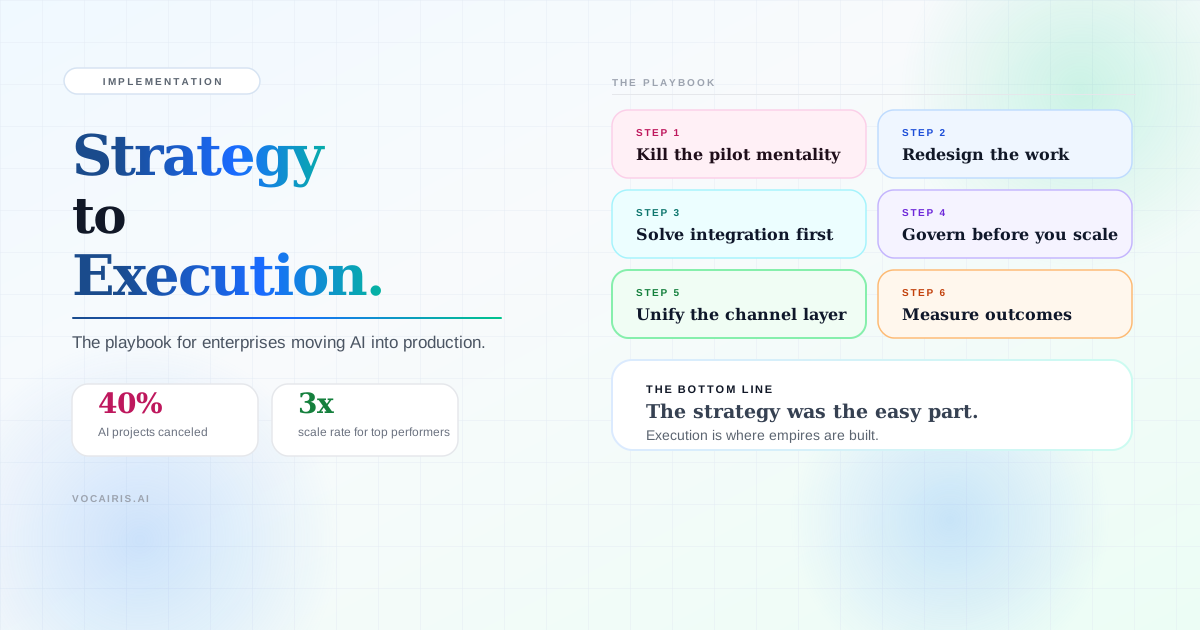
The strategy was the easy part. Execution is where empires are built.
We recently laid out the new AI operating model: scattered AI tools are not a strategy. Vendor-locked agents optimize platforms, not businesses. The winners will be the ones who deploy a unified AI orchestration layer — governed, multi-channel, and wired into real operations.
The response told us something important. Executives are not debating whether the unified model is right anymore. They are asking a different question:
How do we actually get there?
This is the implementation playbook.
The Gap Nobody Talks About
The industry has a scaling problem, and it is worse than most leaders realize.
Gartner predicts that by the end of 2027, more than 40% of agentic AI projects will be canceled due to escalating costs, unclear business value, or insufficient risk controls. McKinsey's 2026 research found that high-performing organizations are three times more likely to scale AI agents than their peers — but the differentiator is not technical sophistication. It is the willingness to redesign workflows rather than layer agents onto legacy processes.
Meanwhile, 46% of organizations cite integration with existing systems as their primary deployment challenge. Not model quality. Not prompt engineering. Integration.
The pattern is consistent: companies that treat AI agents as software deployments fail. Companies that treat them as workforce redesign succeed.
The difference is operating model, not technology.
Step 1: Kill the Pilot Mentality
Most enterprises run AI pilots the same way they run software trials. Small team. Isolated use case. Controlled environment. Success metrics focused on whether the technology works rather than whether the business outcome improves.
This is how you end up with dozens of successful pilots and zero production systems.
The pilot mentality fails because AI agents do not operate like software features. They operate like employees. You would not evaluate a new hire by having them work in a sandbox for six months with synthetic data and no access to real systems. But that is exactly what most AI pilots do.
The fix is counterintuitive: start with production constraints, not proof-of-concept freedom.
Define the business outcome first. Work backward to the workflow. Then deploy the agent into a live environment with guardrails — not into a lab with applause metrics.
The organizations scaling successfully in 2026 share a common pattern: they skip the pilot phase entirely and go straight to governed production with narrow scope. One workflow. One channel. Real data. Real customers. Real measurement. Then expand.
Step 2: Redesign the Work, Not the Tool
Deloitte's Tech Trends 2026 report identifies this as the critical mistake most enterprises make: they deploy agents onto processes that were designed by and for human workers, without reimagining how the work itself should be done.
This matters because AI agents are not faster humans. They are structurally different workers. They do not get tired, but they do lose context. They do not forget policies, but they cannot read a room. They execute consistently, but they need explicit boundaries rather than implicit judgment.
When you layer an agent onto a human workflow, you get an agent doing a bad impression of a person. When you redesign the workflow around what agents do well — and what humans do well — you get a system that outperforms both operating alone.
Practical example: a support workflow designed for human agents routes by department, assumes the agent will pull up account history manually, and relies on escalation when the issue crosses system boundaries. An agent-first workflow routes by intent, surfaces full context automatically, resolves cross-system issues natively, and escalates only when judgment — not information — is the bottleneck.
Same outcome. Fundamentally different design.
Step 3: Solve Integration Before Intelligence
Here is the uncomfortable truth about enterprise AI in 2026: the models are good enough. The orchestration is not.
A 2025 Deloitte survey found that nearly half of organizations cited data searchability and reusability as their top challenges for AI automation. The fundamental issue is that most enterprise data was built for human consumption — structured around dashboards, reports, and manual lookups — not for agents that need to discover context and make decisions in real time.
This is why VocAIris treats integration as a first-class problem, not an afterthought. A unified orchestration layer is only as good as its access to your systems. If your AI cannot pull live order data, check inventory, verify policy compliance, and update records — all within a single interaction — then you do not have an AI workforce. You have a chatbot with ambitions.
The integration architecture matters more than the model architecture. Full stop.
Step 4: Govern Before You Scale
Only about one-third of organizations report mature governance across strategy, oversight, and agentic AI controls. And yet these same organizations are deploying autonomous systems that make decisions affecting customers, revenue, and compliance.
This is not a compliance checkbox. It is a survival requirement.
The enterprises that scale AI successfully govern first and scale second. They establish clear boundaries for what agents can and cannot do. They build audit trails that capture every decision, every action, every escalation. They implement graduated autonomy — starting with AI that recommends and humans that approve, then expanding the agent's authority as trust is earned through measurable performance.
VocAIris bakes this into the platform by design:
- Policy-aware execution — agents operate within your rules, not around them
- Full audit trails — every decision logged, traceable, and reviewable
- Graduated autonomy controls — you define the boundaries, then expand them as confidence grows
- Regulatory alignment — built with frameworks like the EU AI Act in mind from day one
Governance is not the thing that slows you down. It is the thing that lets you speed up without breaking.
Step 5: Unify the Channel Layer
Most enterprises have separate AI for chat, separate AI for voice, separate AI for email. Each has its own context, its own memory, its own logic. A customer who calls after chatting starts over. An agent who escalates from email to phone loses the thread.
This is the interoperability problem, and it is the defining technical challenge of 2026.
The solution is not better handoffs between siloed systems. It is a single intelligence layer that operates natively across every channel. One context. One memory. One set of decisions. The channel becomes a delivery mechanism, not a boundary.
This is what VocAIris delivers: voice, chat, email, text, video, and documents — all connected through a single orchestration layer. Conversations continue across channels without losing context. Handoffs between AI and humans carry full history. Decisions stay consistent because they draw from a unified source of truth.
The result is not just a better customer experience. It is a structurally different operating model — one where the channel is irrelevant because the intelligence is continuous.
Step 6: Measure Outcomes, Not Activity
The final failure mode is measuring the wrong things.
Most enterprises measure AI by activity metrics: tickets resolved, messages handled, calls answered. These tell you the AI is busy. They do not tell you the AI is effective.
The shift is to outcome measurement: revenue influenced, resolution quality, customer retention, time-to-hire, compliance adherence, cost per resolution. These are the metrics that connect AI performance to business performance.
PwC's 2026 findings are stark: 56% of CEOs report no financial impact from AI despite broad adoption. The measurement gap is a major contributor. If you cannot draw a line from AI execution to business outcome, you cannot prove value — and you cannot improve.
VocAIris is built around outcome visibility. Every workflow, every interaction, every decision is tied to a measurable business result. Not vanity metrics. Not activity logs. Results.
The Playbook, Summarized
- Kill the pilot. Deploy into production with narrow scope and real constraints from day one.
- Redesign the work. Build workflows around agent strengths, not human habits.
- Solve integration first. Your AI is only as smart as its access to your systems.
- Govern before you scale. Audit trails, graduated autonomy, policy-aware execution — non-negotiable.
- Unify channels. One intelligence layer across every touchpoint. No more siloed context.
- Measure outcomes. Tie every AI action to a business result. If you cannot measure it, you cannot prove it.
The Window Is Closing
The competitive dynamics of AI in 2026 are not linear. They are exponential. Organizations that get the operating model right this year will compound their advantage every quarter. Organizations that stay in pilot mode will watch the gap widen until catching up becomes structurally impossible.
The strategy was the easy part.
Execution is where empires are built.
This is how you build an AI workforce that actually works.
VocAIris. One AI layer. Every channel. Real outcomes.
Ready to move from strategy to execution? Email us at [email protected]
The next generation of companies will not buy more AI tools.
They will run a governed AI workforce across every channel, every system, and every customer touchpoint.
References
- Gartner — Agentic AI Predictions — 40% of agentic AI projects projected to fail or be canceled by end of 2027; 33% of enterprise software to include agentic AI by 2028.
- Deloitte — The Agentic Reality Check: Tech Trends 2026 — Leading enterprises redesign processes rather than layering agents on legacy workflows; 48% cite data searchability as top AI challenge.
- McKinsey — State of AI Trust 2026 — Only one-third of organizations report mature AI governance; high performers 3x more likely to scale agents.
- PwC — 2026 AI Business Predictions — 56% of CEOs report no financial impact from AI despite broad adoption.
- State of AI Agents 2026 Report — 46% of organizations cite integration as primary challenge; 57% deploy multi-step agent workflows.