AI Workforce: The New Operating Model
80% of enterprise AI pilots never reach production. The winners won't have better models. They'll have a unified AI operating layer — Governed, multi-channel, and wired into real operations.
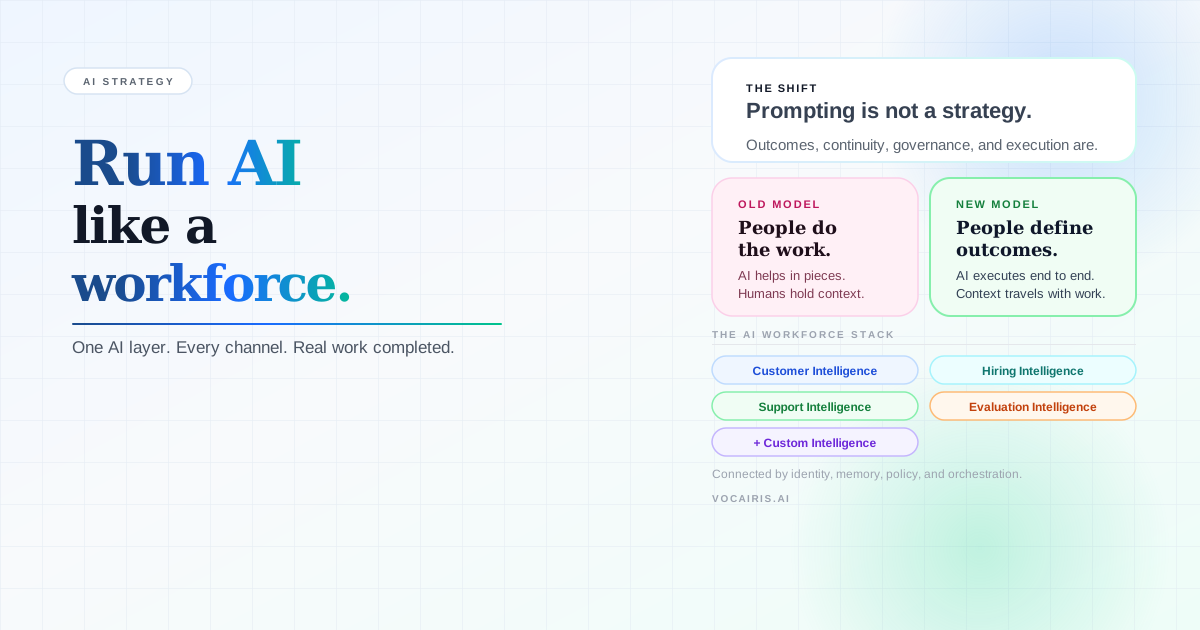
One runtime for memory, orchestration, governance, and action across your business.
Voice, chat, email, SMS, video, and documents working as one continuous operating surface.
Not more answers. Not more copilots. Work that actually gets completed and moved forward.
Stop managing AI. Start directing it.
Most companies did not deploy an AI strategy.
They deployed AI tools. Dozens of them. And the results speak for themselves.
The Problem: AI Became Another Tool
According to Deloitte's State of AI 2026 report, 80% of enterprise AI pilots fail to reach production — double the failure rate of traditional IT projects. Worker access to AI tools climbed 50% last year. Actual business productivity gains? A flat 10%.
The pattern is consistent across industries. MIT research found that 95% of generative AI pilots deliver zero measurable ROI. S&P Global reports that 42% of companies scrapped most of their AI initiatives in 2025 — up from 17% the year before.
Most companies adopted AI like any other software: a chatbot for support, a tool for documents, another for hiring, another for sales.
Each works. None work together.
The result is fragmented workflows, lost context, inconsistent decisions, and humans stuck connecting the dots. As one enterprise study noted, employees spend countless hours every week copying information between systems and manually reconciling outputs that AI was supposed to handle.
That is not transformation. That is fragmentation with better branding.
The Trap: Vendor-Centric AI
Every major platform — Salesforce, ServiceNow, Microsoft — is now pushing AI agents. Salesforce has Agentforce. ServiceNow launched its Autonomous Workforce. Microsoft is scaling Agent 365 and Copilot.
It sounds logical: use their AI inside their ecosystem.
But their AI optimizes their platform, not your business.
The Salesforce-ServiceNow rivalry is a case in point. Industry analysts note that while Salesforce's Atlas engine excels at front-end customer engagement, ServiceNow's AI Control Tower focuses on back-end workflow governance. Microsoft's Copilot dominates general productivity. Each is fighting to become the orchestration layer for the enterprise — but each starts from their own walled garden.
This leads to:
- Sales AI locked inside Salesforce — Agentforce and Einstein serve CRM workflows, not your full revenue cycle
- Support AI locked inside ServiceNow — Now Assist and the AI Control Tower govern IT and service workflows, not your entire customer journey
- Productivity AI locked inside Microsoft 365 — Copilot and Agent 365 boost individual output, not cross-system execution
- Operations AI locked inside SAP — Joule and Joule Studio orchestrate ERP processes, not your end-to-end business
Each operates in isolation. Your business, however, is interconnected. A customer journey spans systems, teams, and channels. No single vendor AI sees the full picture.
The FTC is paying attention. In early 2026, regulators accelerated a probe into bundling practices that prevent smaller, more innovative AI providers from gaining a foothold in enterprise environments.
Over time, this creates:
- AI lock-in — your intelligence is trapped inside someone else's ecosystem
- Disconnected context — agents from different vendors cannot share state or memory
- Duplicated cost — redundant data processing across siloed systems inflates spend
- Innovation ceiling — you can only move as fast as your slowest vendor
You do not get an AI strategy.
You get AI silos inside existing silos.
Why This Is a CEO Problem Now
This is no longer a technology discussion. It is a boardroom imperative.
The Conference Board's 2026 C-Suite Outlook surveyed over 1,700 executives. Nearly 43% named AI and technology as their top investment priority — outpacing product innovation and customer experience. Forty-one percent of executives said measuring AI ROI is their number-one AI priority for 2026.
BCG's 2026 AI Radar survey of 3,000 executives is even more pointed: half of CEOs surveyed believe their job stability depends on getting AI right this year. Corporations plan to double AI spending from 0.8% to 1.7% of revenues. Yet PwC's 2026 Global CEO Survey found that 56% of CEOs report no financial impact from AI investment despite broad adoption.
The gap between investment and results is the defining executive challenge of 2026.
And the root cause is not the model. It is the operating model.
The Shift: From Prompting to Directing
The industry has moved past generative AI and into agentic AI — systems that can reason, plan, and execute multi-step tasks without constant human supervision.
But most enterprises are layering agents onto processes that were designed by and for human workers, without reimagining how the work itself should be done. Deloitte's Tech Trends 2026 report calls this the critical mistake: true value comes from redesigning operations, not just automating old workflows.
The real shift is simple:
You define outcomes. AI executes.
That is the difference between:
- AI as a tool you prompt
- AI as a workforce you direct
PwC describes the emerging model: a centralized orchestration layer that serves as a unified command center — catching mistakes, tracking performance, and aligning AI execution with enterprise priorities. Gartner predicts that by 2028, 33% of enterprise software applications will include agentic AI, up from less than 1% in 2024.
The organizations winning right now are not the ones with the most ambitious AI roadmaps. They are the ones that got the boring fundamentals right: unified data, clear governance, and outcome-based measurement — before they scaled.
VocAIris: One AI Layer Across Your Business
VocAIris replaces scattered tools with a unified AI orchestration layer across:
- Hiring
- Support
- Sales
- Operations
- Documents and compliance
One platform that understands your workflows, speaks across every channel, and preserves context from the first interaction to the last.
Not more copilots. Not more tabs. Not another vendor silo.
One AI layer that gets the job done.
What This Looks Like
Hiring
"Fill this role with the best candidates."
VocAIris matches resumes, conducts structured interviews, scores candidates against your criteria, and delivers ranked shortlists with reasoning — not just names.
With 95% of AI pilots failing to scale, the difference is that VocAIris ships as a production system, not a demo. No integration project. No six-month pilot purgatory.
Support
"Resolve customer issues using our data and policies."
VocAIris handles conversations across chat, voice, and email. It pulls real-time data from your systems, resolves issues instantly against your policies, and escalates with full context — so customers never repeat themselves and agents never start from zero.
Research consistently shows that fragmented AI forces customers to repeat information across touchpoints, driving frustration and abandonment. VocAIris eliminates that gap.
Sales
"Engage and qualify serious buyers."
VocAIris interacts across channels, identifies intent, qualifies based on your criteria, and routes opportunities before they go cold. It does not just generate leads — it works them.
The autonomous agent market is projected to reach $8.5 billion by 2026. The organizations capturing that value are the ones where AI agents do not just assist salespeople — they execute the top-of-funnel work that salespeople never get to.
Documents and Compliance
"Analyze this and flag risks."
VocAIris extracts insights, flags gaps, and aligns decisions with your policies — across contracts, regulatory filings, and internal documentation. Industry estimates suggest that roughly 80% of enterprise data is unstructured. VocAIris turns that unstructured mass into governed, actionable intelligence.
One Platform. Every Channel.
Voice. Chat. Email. Text. Video. Documents.
Everything connected:
- Conversations continue across channels without losing context
- Handoffs between AI and humans carry full history
- Decisions stay consistent because they draw from a single intelligence layer
The interoperability problem — agents from different vendors that cannot communicate — is the defining technical challenge of 2026. VocAIris solves it by design: one platform, one context, every channel.
Built for Control
The enterprises scaling AI successfully share a common trait: they govern before they scale. Only 21% of organizations deploying AI agents have mature governance models. The rest are running autonomous systems without adequate oversight.
VocAIris is built for enterprises that take governance seriously:
- Enterprise-grade security — deploy on your cloud or ours
- Data ownership and isolation — your data stays yours, period
- Full auditability — every decision, every action, logged and traceable
- Policy-aware decisioning — AI operates within your rules, not around them
- Human-in-the-loop controls — graduated autonomy that matches your risk tolerance
- Regulatory readiness — designed with emerging frameworks like the EU AI Act in mind
Built for execution. Built for oversight. Built for the board.
The Outcome: Work Gets Done
AI should not just generate answers. It should complete work.
With VocAIris:
- Workflows are executed end-to-end, not just assisted
- Context is preserved across every channel and handoff
- Decisions are consistent because intelligence is unified
- Teams focus on strategy and outcomes, not on connecting siloed tools
The organizations that master unified AI orchestration in 2026 will pull so far ahead that catching up becomes extraordinarily difficult. The competitive advantage is not linear — it is exponential.
Vendor AI makes their platforms smarter.
VocAIris makes your business smarter.
Stop asking AI how to do things.
Start telling it what needs to be done.
That is the shift.
That is VocAIris.
Ready to see it in action? Email us at [email protected]
The next generation of companies will not buy more AI tools.
They will run a governed AI workforce across every channel, every system, and every customer touchpoint.
References
- Deloitte — State of AI in the Enterprise 2026 — 80% pilot failure rate, worker AI access up 50%, productivity gains flat at 10%.
- BCG — As AI Investments Surge, CEOs Take the Lead (AI Radar 2026) — Half of CEOs believe job stability depends on AI success; corporations doubling AI spend to 1.7% of revenues.
- The Conference Board — C-Suite Outlook 2026 — 43% of executives name AI as top investment priority; 41% say measuring ROI is their #1 AI challenge.
- Deloitte — The Agentic Reality Check: Preparing for a Silicon-Based Workforce — True value comes from redesigning operations, not layering agents on old workflows.
- PwC — 2026 AI Business Predictions — Centralized orchestration as unified command center; 56% of CEOs report no financial impact from AI despite broad adoption.