On-Prem Is Not Legacy. It Is the Future of AI Workloads.
Useful AI at parabolic demand cannot run in a public chat window. It runs on private infrastructure, close to the data — and it needs an AI workforce companies can own.
One runtime for memory, orchestration, governance, and action across your business.
Voice, chat, email, SMS, video, and documents working as one continuous operating surface.
Not more answers. Not more copilots. Work that actually gets completed and moved forward.
On-prem is not legacy. It is where useful AI is going to run — and companies need an AI workforce they can own on top of it.
For two years, most companies treated AI like an experiment: a chatbot here, a copilot there, a proof of concept inside one department. That phase is ending — and with it, the assumption that all AI lives in someone else's cloud.
Jensen Huang said it himself
On NVIDIA's Q1 FY2026 earnings call, CEO Jensen Huang said the quiet part out loud:
"It's really hard to move every company's data into the cloud, so we're going to move AI into the enterprise. We're going to see AI go into enterprise, which is on-prem, because so much of the data is still on-prem."
— Jensen Huang, NVIDIA CEO (Q1 FY2026 earnings call)
That is not a vendor pitching cloud-only AI. That is the CEO of the company selling the picks and shovels of the AI boom telling the market plainly: enterprise data is staying on-prem, so AI has to come to it.
That is exactly why Dell, HPE, and IBM are racing — with NVIDIA — to put production AI inside the enterprise's own four walls.
"On-prem" was never the problem. Static IT was.
"On-prem" once sounded like old infrastructure. In the era of useful AI, it is strategic again — not because every workload belongs on-prem, but because the workloads that matter most do: sensitive data, regulated information, proprietary documents, customer records, and mission-critical workflows.
Enterprises need the full deployment spectrum:
- public cloud when appropriate
- private cloud when control matters
- hybrid when data and workflows span environments
- on-prem / in-house when compliance, latency, sovereignty, or cost require it
The future is not one cloud. The future is deployable AI.
Move AI to the work, not the work to AI
Most enterprise work does not happen in one clean cloud application. It happens across legacy databases, ERP and CRM systems, file shares, call recordings, contracts, policies, and private workflows built over years.
At that scale, "move all the data to the AI platform" breaks down. The better model is the reverse:
Move AI to where the work and data already live.
But infrastructure alone is not enough. Servers, GPUs, and private cloud are the foundation. Companies still need the workforce layer — AI employees that perform business work on top of it.
VocAIris is the deployable AI workforce layer
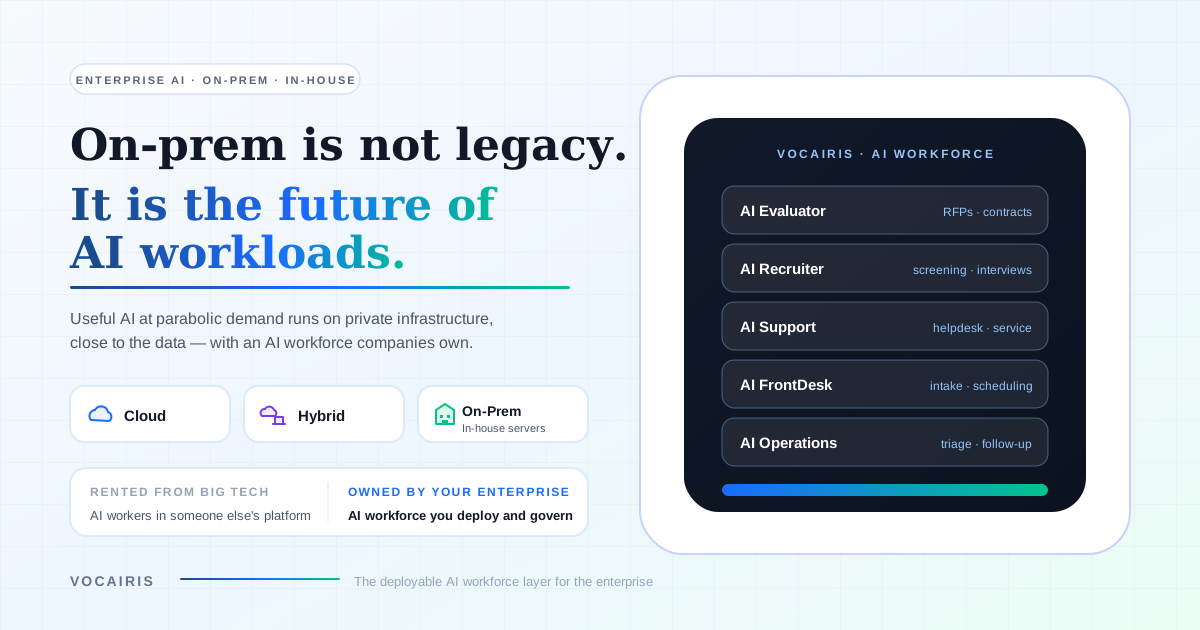
VocAIris deploys in the environments enterprises already trust: cloud, private cloud, hybrid, or on-prem. Instead of renting generic AI workers inside a Big Tech ecosystem, companies get a deployable layer of AI employees that operate around their own data and systems:
- AI Evaluator — RFPs, proposals, contracts, policies, compliance documents
- AI Recruiter — resume analysis, screening, interviews, candidate scoring
- AI Support — helpdesk, service center, internal knowledge access
- AI FrontDesk — intake, scheduling, routing, customer-facing operations
- AI Paralegal — document review, issue spotting, evidence organization
- AI Operations — process follow-up, workflow triage, internal automation
These are not bots. They are AI workers deployed close to the company's business context.
Rented AI workers vs. owned AI capacity
The real question is not whether companies will use AI workers. It is who owns the AI workforce?
If every AI worker lives inside a hyperscaler, CRM vendor, or productivity suite, the company is renting its future labor force — with vendor lock-in, fragmented workers, limited data control, unclear governance, and dependence on someone else's roadmap. When the worker is software, companies should not have to rent every role forever.
Your AI workforce should belong to your enterprise, not to Big Tech's platform.
The bottom line
Private AI infrastructure without business-ready AI workers is still just infrastructure. VocAIris turns it into usable AI labor — workers that read documents, screen candidates, resolve tickets, handle intake, and move internal work forward across voice, video, chat, and documents, governed and audited by the enterprise.
On-prem is not legacy. It is the future of AI workloads — and VocAIris is the deployable AI workforce layer built for it: cloud, private cloud, hybrid, or on-prem.
The next generation of companies will not buy more AI tools.
They will run a governed AI workforce across every channel, every system, and every customer touchpoint.
References
- CIO Dive: Nvidia's next AI move — bringing GPUs into the enterprise (Q1 FY2026 earnings call coverage with Jensen Huang's on-prem quote)
- NVIDIA: Jensen Huang at Dell Technologies World 2026
- HPE: Secure, scalable production-ready AI with NVIDIA
- IBM and NVIDIA: Expanded collaboration to advance enterprise AI