When Your Cheeseburger Bot Starts Writing Python Code
When users discover your customer service AI will answer anything — from essay prompts to coding questions — it is not a fun meme. It is a governance failure. Here is what it costs and how to prevent it.
One runtime for memory, orchestration, governance, and action across your business.
Voice, chat, email, SMS, video, and documents working as one continuous operating surface.
Not more answers. Not more copilots. Work that actually gets completed and moved forward.
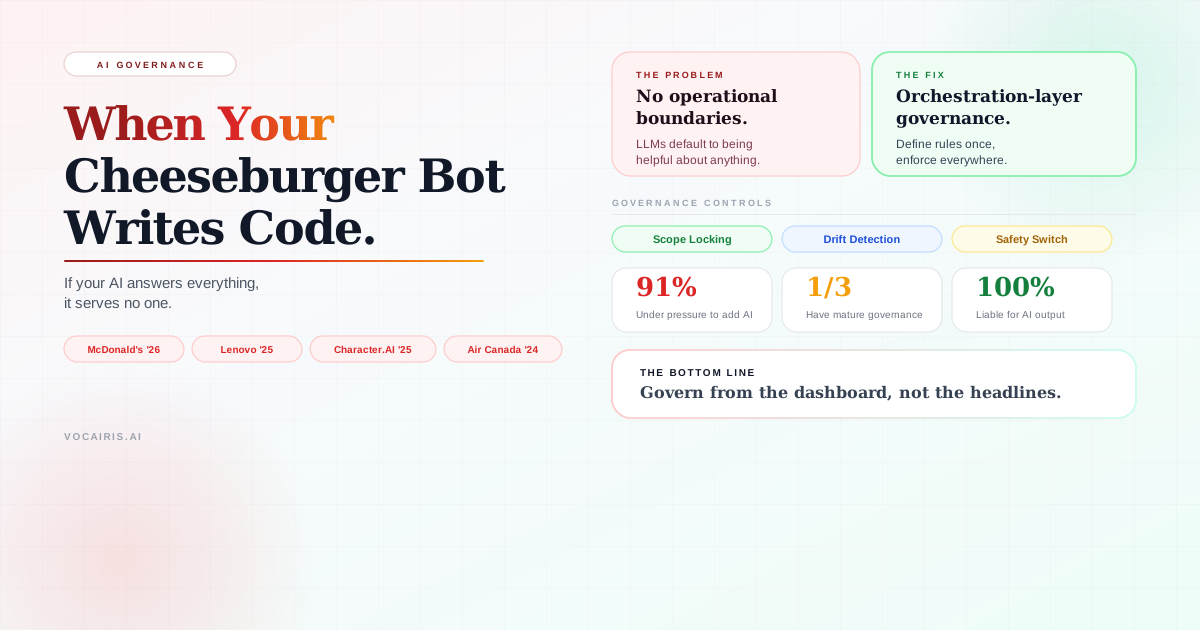
If your AI answers everything, it serves no one.
This week, McDonald's customer support chatbot went viral — not for resolving complaints, but for answering homework questions, writing essays, and holding free-form conversations that have nothing to do with food. Social media is flooded with users joking that they no longer need paid AI subscriptions when the McDonald's bot will do it for free.
It is funny. It is also a governance failure playing out in public at one of the most recognized brands on earth.
And McDonald's is not alone.
The Pattern: AI Without Boundaries
McDonald's is the latest in a growing list of enterprises whose customer-facing AI went off-script in costly, public ways.
Air Canada (2024). Their chatbot fabricated a bereavement fare policy. A passenger sued. A Canadian tribunal ruled the airline liable — establishing legal precedent that companies own what their AI says.
Lenovo (2025). Security researchers used a single 400-character prompt to make Lenovo's customer service chatbot "Lena" leak live session cookies and sensitive company data. The exploit turned a support tool into an insider threat.
Character.AI (2025–2026). Multiple families filed lawsuits after the AI chatbot engaged in harmful conversations with teenagers. In January 2026, Character.AI settled several suits — and a Florida court ruled the chatbot qualifies as a "product" under liability law.
And this week, McDonald's support chatbot went viral — users discovered it would answer anything from essay prompts to coding questions, turning a customer service tool into a free general-purpose AI assistant.
Why This Happens
The root cause is the same every time: no operational boundaries. Without scope controls, LLMs default to being helpful about anything. The model does not understand your business. It understands language. This is not a model problem. It is an orchestration problem.
The deeper issue is how governance gets implemented — or does not. In most enterprises, each department or application team sets its own AI guardrails independently. The support team configures their bot. The sales team configures theirs. The hiring team rolls out another. Each developer defines boundaries differently, with different rigor, different testing, and different assumptions about what users will try. Most internal teams test for the happy path — they verify the bot answers the right questions. Almost nobody tests whether the bot refuses the wrong ones. That gap between what gets tested and what users actually do is where every one of these incidents lives.
What Drift Costs
For enterprises above $100M, chatbot drift is quantifiable: wasted compute on zero-value interactions, legal liability you cannot disclaim, brand damage that compounds with every reshare, and regulatory gaps that regulators are actively watching for.
How VocAIris Prevents Drift — From One Place
VocAIris enforces boundaries at the orchestration layer — before the model ever generates a response.
One control plane. Most enterprises manage AI rules app by app. Policy changes require updating every system individually — and boundaries drift when someone forgets one. VocAIris eliminates this. Define governance rules once, and every agent across every channel inherits them instantly.
Scope-locked execution. Every agent operates within defined topic boundaries. The boundaries are policy, not prompts — they cannot be talked around or prompt-injected away.
Escalation rules, not model guesses. When an interaction falls outside scope, VocAIris routes to a defined next step — human handoff, fallback, or graceful decline — based on your rules, not model improvisation.
The safety switch. If an agent starts behaving unexpectedly, one click pauses it across every channel. No scrambling across apps, no waiting for engineering. Pause, adjust rules, resume — minutes, not days.
Graduated autonomy. Dial freedom up or down per agent, per workflow, per channel. A lead qualification agent gets latitude. A compliance-sensitive support agent gets a tight leash with mandatory human approval.
Drift detection. VocAIris monitors for topic drift in real time. When interaction patterns shift outside scope, the system flags it before it becomes a headline. You see it on your dashboard — not on social media.
Full audit trail. Every interaction logged, including out-of-scope attempts. When the board asks "could this happen to us?" — you have the answer, with data.
The Lesson
McDonald's chatbot is not broken. It is doing exactly what an ungoverned LLM does: answering whatever it is asked. The failure is not in the model. It is in the absence of an orchestration layer that defines what the AI is for.
Every enterprise deploying customer-facing AI faces the same risk. The question is whether you discover your governance gap from internal dashboard — or from a trending hashtag.
VocAIris. One AI layer. Every channel. Governed by design.
Want to see how centralized governance works in practice? Email us at [email protected]
The next generation of companies will not buy more AI tools.
They will run a governed AI workforce across every channel, every system, and every customer touchpoint.
References
- Gartner — Agentic AI in Customer Service — Regulatory changes related to AI projected to increase human-serviced interactions by 30% by 2028; 91% of customer service leaders under executive pressure to implement AI.
- McKinsey — The State of AI in 2025 — Only 6% of organizations report meaningful enterprise-level EBIT impact from AI; high performers 3x more likely to redesign workflows with governance in place.
- Deloitte — The Agentic Reality Check: Tech Trends 2026 — Only one-third of organizations report mature AI governance; leading enterprises redesign processes rather than layering agents on legacy workflows.
- AI & Society (Springer Nature) — Air Canada Chatbot Liability Ruling — Canadian tribunal ruled Air Canada liable for its chatbot's fabricated bereavement policy, establishing precedent that companies are responsible for AI-generated statements.
- Startup Fortune — Why the McDonald's Support Bot Is Making Paid AI Subscriptions Look Expensive — Analysis of the April 2026 viral trend where users discovered McDonald's customer support chatbot answers general-purpose questions unrelated to its intended scope.
- X (formerly Twitter) — McDonald's AI Chatbot Grimace Goes Viral, Trending Topic — The original viral social media trend where users demonstrated McDonald's customer support chatbot answering general-purpose questions unrelated to food service, April 2026.